 (CAD) $
Most people have been using the wrong skincare products for years. Not because they don’t care. Because nobody ever taught them how to figure out what their skin actually needs.
It starts with one thing. Knowing your skin type.
Get that right and everything else — cleansers, moisturizers, serums, SPF — becomes a much easier decision. Get it wrong, and you spend money on products that don’t work, or worse, make things worse.
How Do You Actually Figure Out Your Skin Type?
There’s a simple test. It takes about an hour of your time and costs nothing.
Wash your face with a gentle, plain cleanser. Don’t apply anything after. Wait 60 minutes. Then look in the mirror and notice what you feel.
- Tight and uncomfortable? Likely dry
- Shiny all over? Likely oily
- Shiny in the middle, dry on the sides? Likely combination
- Calm and balanced? Likely normal
- Reacting, stinging, or red? Likely sensitive
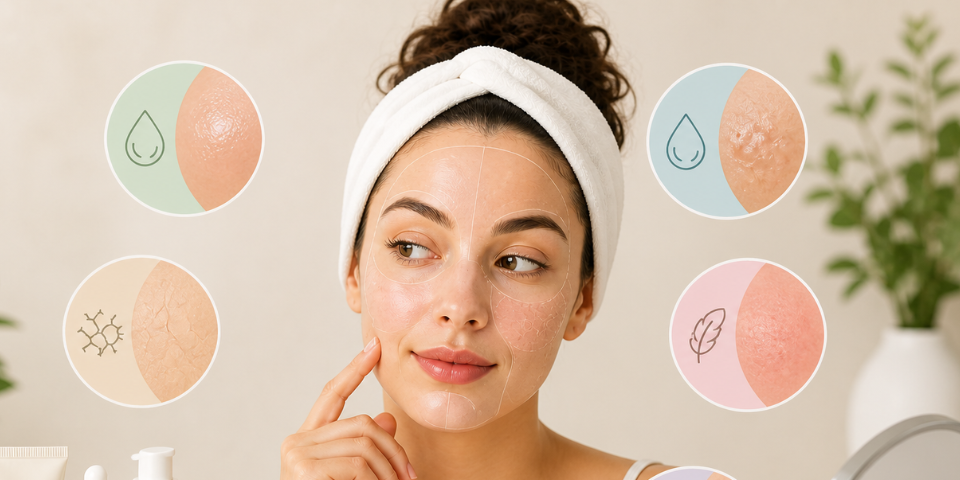
Before we begin, let’s take a quick look at the chart below to identify your skin type:
| Skin Type | Characteristics | How to Identify |
| Normal | Not too dry or oily – Balanced with minimal blemishes & smooth texture. | Skin feels comfortable to touch. No excessive dryness or shine. |
| Dry | Dull appearance with tight, flaky & rough texture. Visible fine lines. | After washing, the skin feels tight. It might even have dry patches. |
| Oily | Shiny T-zone (forehead, nose & chin), enlarged pores. | Skin looks shiny & is oily to the touch. It is prone to acne & blackheads. |
| Combination | Mix of oily and dry areas. | Cheeks are dry, and the T-zone is oily. |
| Sensitive | Stinging sensation, burning, itchy or red skin. Skin becomes prone to irritation and reactions. | Skin reacts to products easily, appearing inflamed sometimes. |
Choosing Products Based on Your Skin Type
Normal Skin
Normal skin is balanced. Not too oily. Not too dry. Minimal breakouts. Small pores. If this matches your skin’s description, then you don’t need to do much to keep it fresh.
Though you are lucky to have this skin type, you still need to take care of it. Even a little bit of neglect can make it dry or oily.
What to look for:
- A gentle cleanser with a gel or foaming formula that doesn’t strip moisture
- A moisturizer with a light formula containing glycerin or hyaluronic acid
- SPF 30 sunscreen
- A Vitamin C serum is an antioxidant to protect your skin and for brightness
What to avoid:
- Creams with occlusive formulas that clog pores
- Harsh exfoliants used too frequently
- Skipping SPF because your skin “looks fine.”
Normal skin is forgiving. But a consistent basic routine keeps it that way.
Dry Skin
Dry skin lacks both water and oil. This is an essential detail to remember. This tells you that dry skin requires products with richer and occlusive formulas. This will not only support the skin barrier but also lock in moisture.
What to look for:
- An oil-based or creamy cleanser that doesn’t create heavy foam
- A moisturizer rich in squalene, shea butter and ceramides
- A high-quality hyaluronic acid serum that must be applied before moisturizer and on damp skin
- A facial oil for extra nourishment in cold or dry weather
- SPF formulas that are moisturizing rather than mattifying
What to avoid:
- Foaming cleansers with sulphates — they strip what little oil your skin has
- Alcohol-heavy toners or astringents
- Retinoids at high concentrations, without building up slowly
- Hot water when washing your face — it pulls moisture out fast
Dry skin responds well when you stop stripping it and start feeding it.
Oily Skin
Oily skin produces too much sebum. Here’s what most people with oily skin get wrong. They try to dry it out. They use harsh cleansers and skip moisturizer. That actually makes oil production worse. Your skin overcompensates when it’s stripped.
What to look for:
- A gentle gel or foaming cleanser that removes excess oil without stripping
- An oil-free, non-comedogenic moisturizer — yes, oily skin still needs hydration
- Niacinamide serum to regulate sebum production and minimize pores
- A mattifying SPF that won’t feel heavy
- Clay masks once or twice a week to manage congestion
What to avoid:
- Heavy creams or oils that sit on the surface and block pores
- Skipping moisturizer — this is the most common mistake
- Cleansing the face more than two times a day
- Comedogenic ingredients like cocoa butter or coconut oil
When it comes to oily skin, the goal is not to eliminate sebum. It’s to balance it!
The goal with oily skin isn’t to eliminate oil. It’s to balance it.
Combination Skin
Combination skin is tricky because one product rarely works perfectly across the whole face. What hydrates your cheeks may break out on your nose.
What to look for:
- A balanced gel cleanser that doesn’t over-dry or over-moisturize
- A lightweight moisturizer across the whole face
- A targeted approach — slightly heavier product on dry areas, lighter on oily zones
- Niacinamide to regulate oil in the T-zone without drying your cheeks
- Gentle exfoliation once or twice a week to keep pores clear
What to avoid:
- Rich, heavy creams applied all over
- Very drying products used across the whole face
- Ignoring the dry areas because the oily areas feel fine
Combination skin rewards a slightly tailored approach. Think of it as two skin types that happen to share a face.
Sensitive Skin
Sensitive skin isn’t a skin type in the same clinical sense as the others. It’s more of a condition — often linked to a weakened skin barrier. But it changes everything about how you shop.
What to look for:
- Products with zero fragrance
- Products with minimal ingredients. The lighter the formula, the lower the chances of adverse reactions
- Non-foaming, gentle cleansers with ingredients like aloe or Centella
- Moisturizers with niacinamide and ceramides that support the skin barrier
- Sunscreens with mineral SPF, containing zinc oxide rather than chemical filters
What to avoid:
- Products with the word “unscented” in their label. These still contain masking fragrance
- Strong actives, such as AHAs, Vitamin C, or retinoids, in high percentages
- Changing your whole routine at once — introduce one product at a time
- Believing the product is hypoallergenic just because the label says it. Read the entire list of ingredients
Sensitive skin needs patience and simplicity. A short, consistent routine with gentle ingredients will always outperform an ambitious one packed with active ingredients.
The Bottom Line
Your skin type creates the base for whatever you apply to it. It whispers in your ears what product to choose and what to leave on the shelf. It’s worth repeating that a skincare routine with 10 products doesn’t mean you are doing it right.
Now that you have figured out your skin type, the next step is to do a patch test. Always introduce new products to your skincare routine slowly.
Remember – Your skin changes with age, hormones and the seasons. Meaning: A product that did wonders for your skin at 25 might not show the same magic when you are 35.
So, pay attention to what your skin is telling you. It’s usually pretty clear.